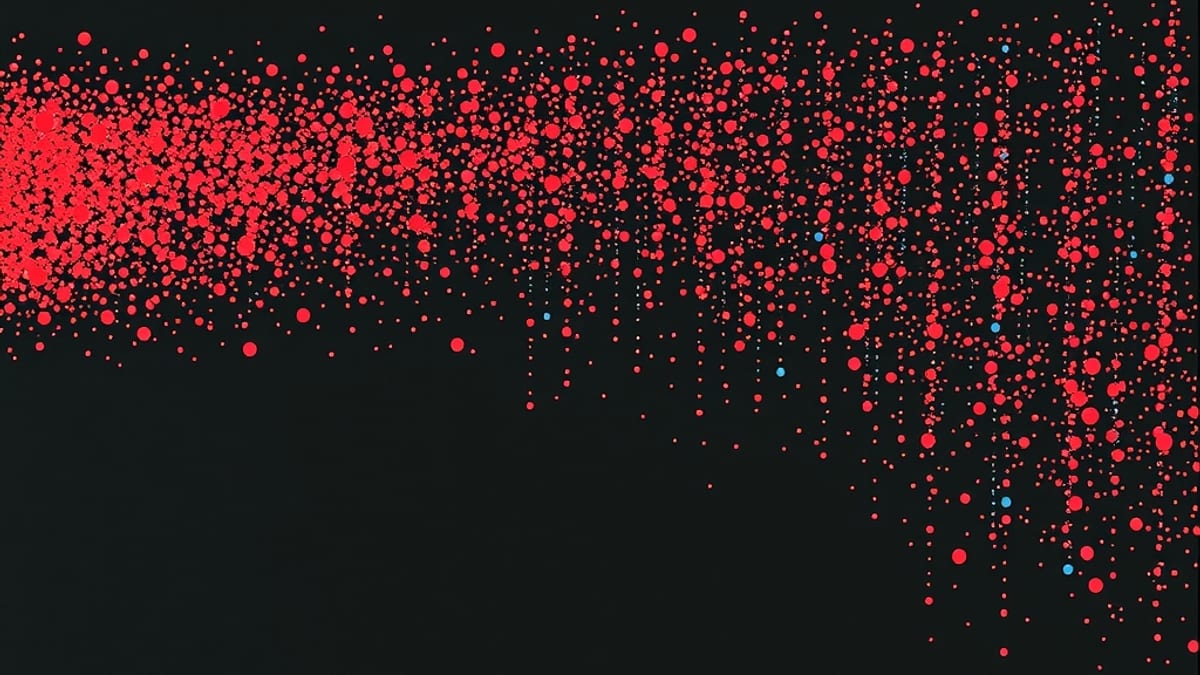
Researchers have developed EventDiffusion, a new generative framework that learns to create realistic event camera data directly from real-world recordings. This approach addresses the scarcity of such data, which has been a limitation for developing new algorithms. EventDiffusion decomposes the generation process into three probabilistic stages, aiming to improve the fidelity and diversity of synthetic event streams.
The scarcity of data for event cameras, which capture asynchronous brightness changes at high temporal resolution, has constrained the development of data-driven research in this field. Existing methods for simulating event data often rely on prescribed sensor dynamics and estimated brightness trajectories, limiting the realism of the generated streams. EventDiffusion tackles this by learning the conditional distribution of native asynchronous event streams directly from recorded data.
The framework introduces three probabilistic processes. First, Event Activity Diffusion (EAD) learns the stochastic counts of discrete events. Second, Event Spatial Allocation (ESA) distributes these counts to individual pixels while preserving their quantity. Finally, Event Timing Diffusion (ETD) learns the continuous asynchronous timestamp distributions for these events. This hierarchical approach allows EventDiffusion to generate more plausible and varied event streams compared to previous simulation methods.
To evaluate the quality of the generated data, the researchers also introduced CEFS, a new metric for assessing the realism of event streams. CEFS combines measures of event activity and polarity with multiscale space-time structure and temporal fidelity. In experiments across various datasets, EventDiffusion reportedly achieved double the accuracy of state-of-the-art methods and demonstrated robustness across different event camera models and resolutions.
Event cameras, which mimic biological retinas, offer advantages such as high temporal resolution, high dynamic range, and low bandwidth usage by only recording brightness changes. However, the unique asynchronous nature of their output requires specialized methods for processing and simulation. Previous work has explored generative models for event data, including methods for pose tracking and video reconstruction. Other research has focused on synthesizing event data guided by different control signals, such as text labels or human poses, using diffusion models. Additionally, diffusion models have been adapted for event-based video frame interpolation.
The development of EventDiffusion represents a step towards overcoming the data limitations in event-based vision research. By learning directly from native recordings, the framework aims to provide a more accurate and diverse source of synthetic data for training and evaluating event camera algorithms.