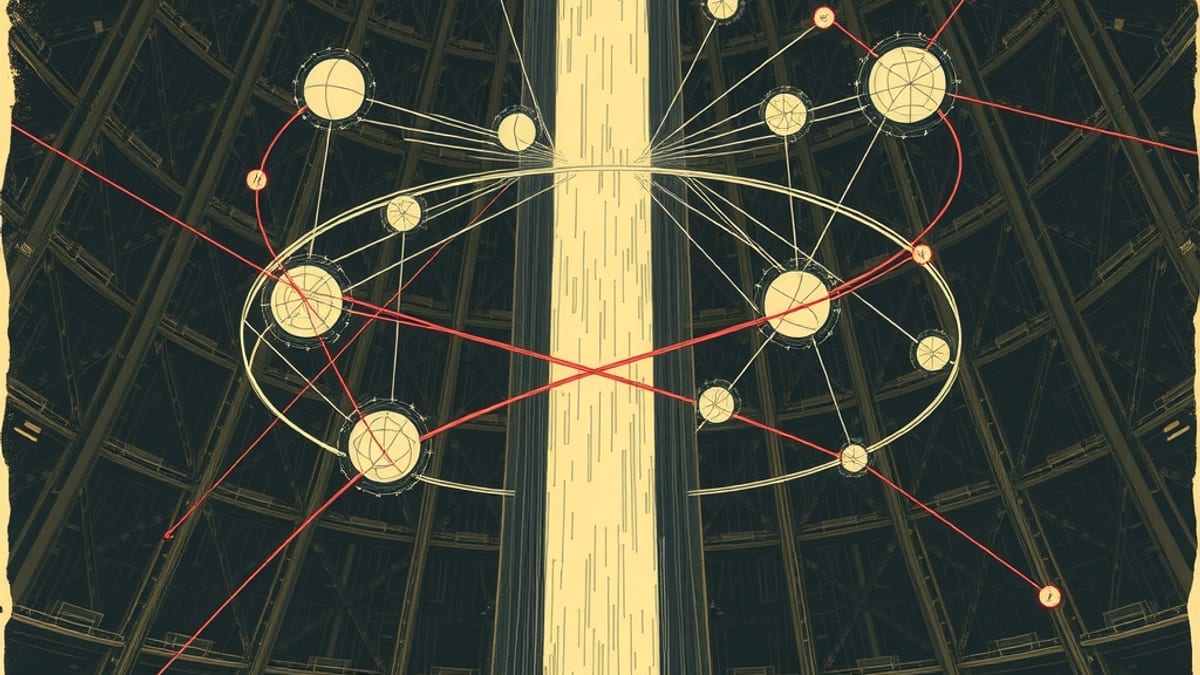
A team of physicists has introduced EveNet, an event-level foundation model for analyzing particle collider data, published in Nature Machine Intelligence. This model aims to address computational challenges in high-energy physics by providing a unified framework for diverse analyses. EveNet was pretrained on approximately 500 million simulated collision events using a hybrid objective that combines self-supervised learning with physics-informed supervision.Modern collider experiments, such as those at the Large Hadron Collider (LHC), generate petabytes of data from high-energy proton collisions. Analyzing this data to identify and characterize new particles typically requires hundreds of specialized analyses, each often necessitating the development and training of a bespoke model. This process can be computationally intensive and limited by the availability of simulated signal events. EveNet seeks to overcome this bottleneck by offering a single, pre-trained model adaptable to multiple tasks.EveNet employs a shared particle-cloud representation, constructed from the variable-length sets of physics objects in each collision event. These objects include jets, electrons, and muons, along with their kinematic properties, flavor-tagging information, lepton identification, and charge. The model's architecture is a hybrid point-edge transformer. Its transformer backbone handles the modeling of physics object sets through attention-based interactions, while k-nearest-neighbor message passing integrates local geometric structure.The pretraining of EveNet involved a two-stage curriculum. Initially, a self-supervised generative head was active, utilizing a diffusion-based objective to reconstruct masked portions of the particle cloud. The masking probability increased progressively from 30% to 100%. In the second stage, supervised objectives were added, including classification into ten physics-process categories and a supervised generative head that reconstructs invisible event components, such as neutrino momenta, conditioned on the observed objects.The researchers validated EveNet's performance across four distinct high-energy physics tasks. These included searches for exotic Higgs decays, precision measurements of quantum correlations, and anomaly detection. In tests, EveNet demonstrated stronger performance than existing transformer-based models, achieving comparable results with approximately one-third fewer training steps. For instance, in a benchmark for new physics searches involving a heavy particle X decaying into a lighter particle Y and a Standard Model Higgs boson, EveNet showed improved data efficiency in low-statistics regimes.Furthermore, the model's transferability to experimental data was validated by rediscovering the Upsilon meson using CMS Open Data. This demonstrated that EveNet, trained solely on simulated events, maintains strong performance on real collision data. The model also showed robustness against systematic variations in jet-energy-scale and missing-transverse-momentum, with its precision shifts remaining within tight bounds compared to scratch-trained models.While the initial results are promising, the authors acknowledge limitations. Predictions from different task heads are not explicitly constrained for mutual consistency, and detailed systematic stress tests under significant simulation-to-data mismatches have not yet been performed. A comprehensive analysis of the latent-space organization and interpretability is also reserved for future work. The decisive next step for EveNet will be its deployment in actual LHC analyses.
EveNet Foundation Model Accelerates Particle Collision Data Analysis Across Diverse Physics Tasks
Researchers developed EveNet, a foundation model designed to analyze particle collision data, which demonstrates improved efficiency and accuracy in high-energy physics experiments. The model, trained on 500 million simulated collision events, can be adapted to various analytical tasks, potentially streamlining discovery at colliders.