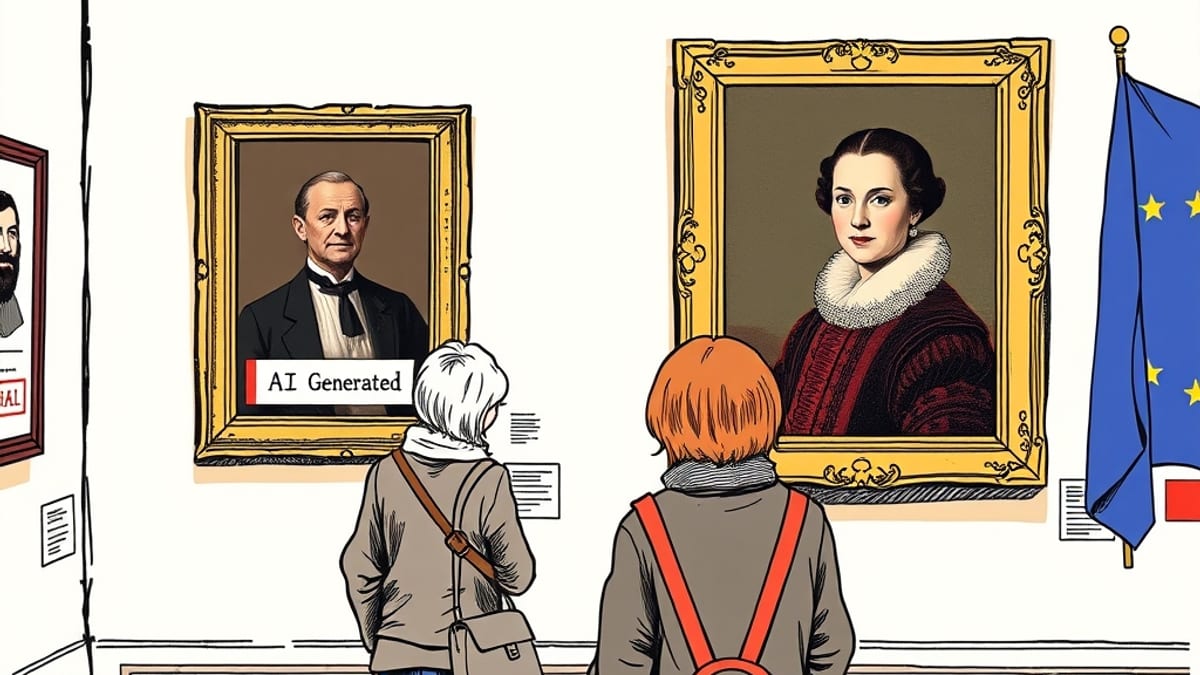
Starting Sunday, August 2, 2026, companies operating within the European Union must clearly label artificial content that is designed to look real. This mandate, stemming from the EU's Artificial Intelligence Act, requires disclosure when users interact with AI-generated images, audio, or text that could be mistaken for authentic material. The regulations are intended to combat the spread of deceptive content and safeguard democratic integrity.
The transparency rules apply to new AI systems introduced to the EU market from August 2. Existing systems have an additional four months to comply with the new labeling requirements. The legislation targets synthetic text, images, video, and audio that are crafted to appear truthful. Such content must be visibly marked as AI-generated and potentially include a digital watermark indicating its artificial origin. Texts presented on matters of public interest will also require an AI label if they have not undergone human editorial oversight.
Sergey Lagodinsky, a Member of the European Parliament who helped negotiate the AI Act, stated that these rules are crucial not only for consumer protection but also for the protection of democracy. "Making transparent this information is something which we need to preserve our democracy and the authenticity of facts online," Lagodinsky told The Guardian.
The AI Act divides responsibilities between providers and deployers of AI systems. Providers, the firms that develop generative AI technologies, must embed machine-readable markings within their systems. These markings enable the detection of AI-generated or manipulated content. Deployers, which include companies and individuals using AI to create content, are responsible for the visible disclosure to the audience. This means anyone using AI to produce a deepfake or publish machine-written text on public interest topics must clearly inform the audience of the content's origin. The obligation to label realistic deepfakes applies regardless of the creator's intent to deceive.
AI-powered chatbots and virtual assistants are also covered by these rules. Users must be informed at the outset of their interaction that they are communicating with an AI system, rather than through obscure terms of service. However, the regulations include specific exemptions. Content that is clearly unrealistic, fantastical, artistic, satirical, or fictional is generally excluded from mandatory labeling. AI-generated text also escapes the labeling requirement if a human with genuine editorial responsibility has reviewed it.
The enforcement of these rules is backed by significant penalties. Breaches of the AI Act's transparency obligations can result in fines of up to €15 million or 3% of a company's worldwide annual turnover, whichever amount is greater. These penalties are designed to ensure compliance across the industry.
The European Commission has encouraged companies to adopt these labeling practices voluntarily. A Code of Practice on Transparency of AI-Generated Content has been developed, providing a practical framework for compliance. Over 180 organizations have signed this code, signaling their intent to adhere to the new regulations. While signing the code is voluntary, the transparency obligations themselves are legally binding. The EU has also developed a set of icons that creators can use to label AI-generated content, which are freely available.
The reach of the EU's AI labeling rules is expected to extend beyond the bloc's borders. Global platforms often adopt uniform systems for all markets, suggesting that the EU's approach may influence AI content labeling practices worldwide, similar to the impact of the EU's privacy regulations. However, the effectiveness of these rules will depend on the continuous development of detection tools that can keep pace with the rapid advancement of AI generation capabilities.