Discovered Materials, a startup focused on AI-driven materials discovery for the semiconductor industry, announced it has secured $9 million in seed funding. Lightspeed India Partners led the round, with participation from Peak XV Partners and angel investors including Paul Graham, Gokul Rajaram, and Tarik Shihipar. The capital will be used to scale the company's AI agents and accelerate the research and development timeline for novel semiconductor materials.
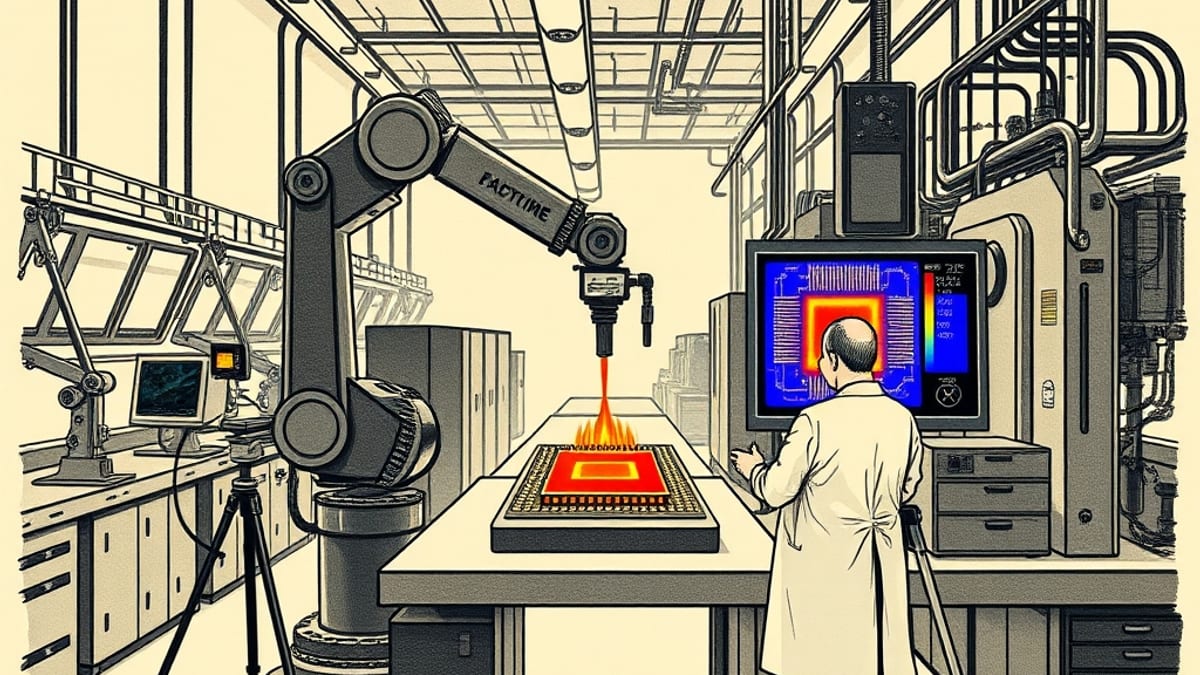
The company, founded by Adwait Sridhar and Akash Ramdas, is addressing the growing thermal challenges in advanced computing, particularly with AI workloads. Modern graphics processing units (GPUs) can generate heat fluxes of approximately 140 W/cm², a level comparable to the nose cone of a space shuttle re-entering Earth's atmosphere. This heat generation leads to substantial electricity consumption for cooling in data centers and can limit chip performance.
Discovered Materials employs a software pipeline that integrates Anthropic AI models within a specialized environment to identify potential new materials. The company then uses trained physical models to run simulations and assess the viability of these candidate materials. According to co-founder Adwait Sridhar, these cloud-based AI agents operate continuously, generating thousands of hypotheses daily. This contrasts with the estimated 20 hypotheses a human researcher might review in a day, a figure based on co-founder Akash Ramdas's experience during his doctoral studies.
Akash Ramdas holds a Ph.D. in materials science from Stanford University, where his research on nanoscale interconnect materials has been adopted into the roadmaps of major chip manufacturers such as Intel and TSMC. Adwait Sridhar previously worked on AI agents at Persona AI and Luma Labs. The combination of deep materials science expertise and AI engineering is central to the company's approach, aiming to compress years of traditional materials research and development into a matter of days.
The company has also released the "Material Discovery Bench," a benchmark designed to track the performance of frontier AI models in solving real-world material discovery problems for semiconductor applications. Alongside this, Discovered Materials has made public examples of hundreds of new materials identified by its AI models. The goal is to facilitate faster adoption of new materials, moving them from scientific experimentation to industrial fabrication, a process traditionally hindered by significant time and cost.
While Discovered Materials has indicated it has already identified several materials with properties matching those used by major chip manufacturers, specific details have not been disclosed. The development of new materials for semiconductors is a complex undertaking, as any new material must not only address thermal issues but also possess suitable electrical characteristics and be compatible with existing chip production processes.
The investment in Discovered Materials reflects a broader trend of increasing venture capital interest in AI-driven materials discovery. Companies like MatNex, SandboxAQ, and CuspAI are also active in this field. CuspAI, for example, raised over $100 million in Series A funding in September 2025 for its platform that combines generative AI with physics-based simulations to discover materials for industrial and climate applications. Materials Zone, another AI cloud-based materials discovery platform, secured $6 million in Series A funding in April 2021. The United States has been a leading region for investment in materials discovery, with a surge in pre-seed and seed funding indicating strong interest in the sector.
Discovered Materials plans to patent the use of any promising materials it discovers. The company's focus on thermal issues in semiconductor materials addresses a critical bottleneck for the continued advancement of AI and other high-performance computing technologies.