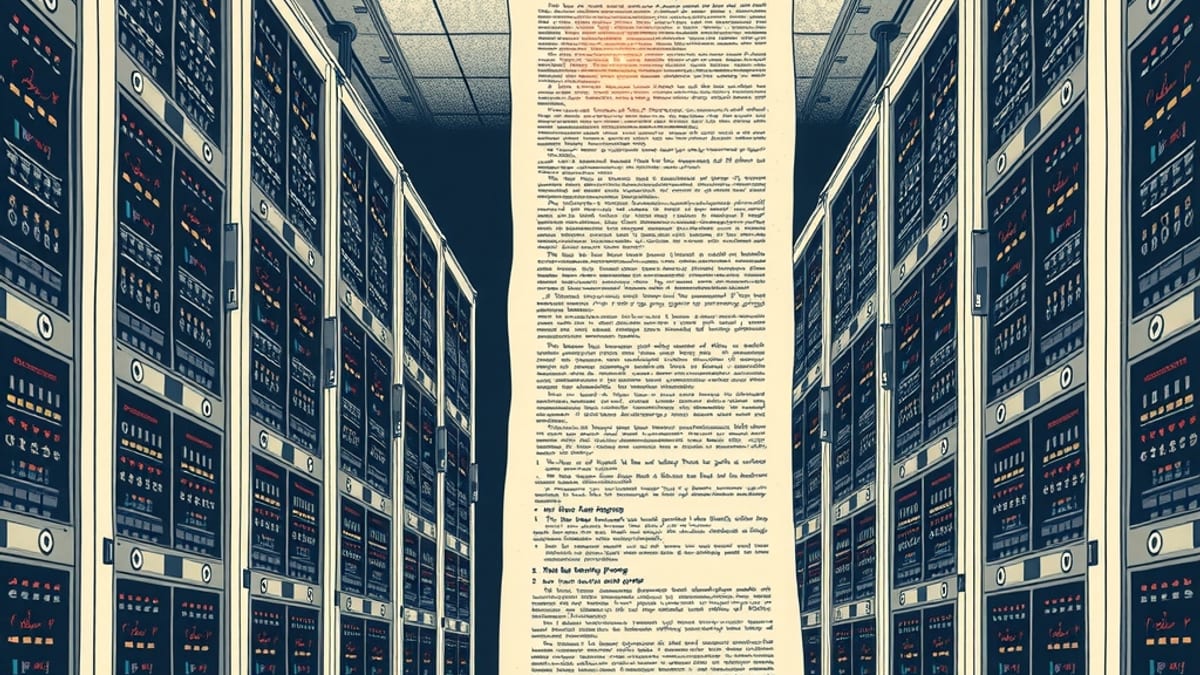
Google DeepMind announced AlphaProof Code on November 10, 2026, describing it as a multi-agent AI framework designed for formal software specification and verification. The initial application of AlphaProof Code involved proving key security properties of `libsignal`, the reference implementation of the Signal protocol, at the machine-code level. This marks the first instance of AI formally verifying a widely deployed cryptographic protocol at such a depth, and the first time its implementation has been formally verified by any method.
The verification process for Signal's core encryption involved a collaborative effort between human researchers and AI agents. Researchers worked with various AI models to translate Signal's security goals into formal mathematical specifications, with human experts reviewing each specification. Subsequently, AI agents, powered by Gemini Carbon, generated the proofs, producing about 6.5 million lines of Lean code. Lean is a computer language that mathematically verifies the accuracy of code. The agents also audited their own proofs, flagging approximately one percent of the codebase for human review, which significantly reduced the time experts would typically spend on such a task.
The proofs specifically cover Signal's post-quantum PQXDH handshake and its Triple Ratchet in `libsignal v0.105.4`, checked against the compiled AArch64 machine code. The verified properties include forward secrecy, authentication, post-compromise security, and handshake secrecy. These properties ensure that past messages remain secure even if a key is compromised later, that conversations can recover security after a temporary device compromise, and that users are communicating with the intended party while initial keys remain confidential. The work focused on one-to-one sessions, with group messaging, key generation, and side channels outside the scope of this initial verification.
A team of five researchers completed the proof work in four weeks. DeepMind stated that a similar task would have historically required years of expert labor. The project did not identify any new vulnerabilities in Signal. However, to validate the effectiveness of the specifications, researchers reintroduced two previously fixed bugs into `libsignal`, a weak-state bug and a missing small-subgroup check, and AlphaProof Code successfully generated Lean proofs demonstrating that the modified binaries violated the security theorem.
Ehren Kret, Signal's Chief Technology Officer, commented that using AI agents to translate live code into valid Lean theorems represents a major breakthrough. He added that this approach allows for significant expansion beyond earlier, more limited verification efforts. DeepMind has published the full Lean development, specifications, and proofs for public review. The company suggests that the methodology could be applied to other critical software systems, such as medical device firmware and power grid software.