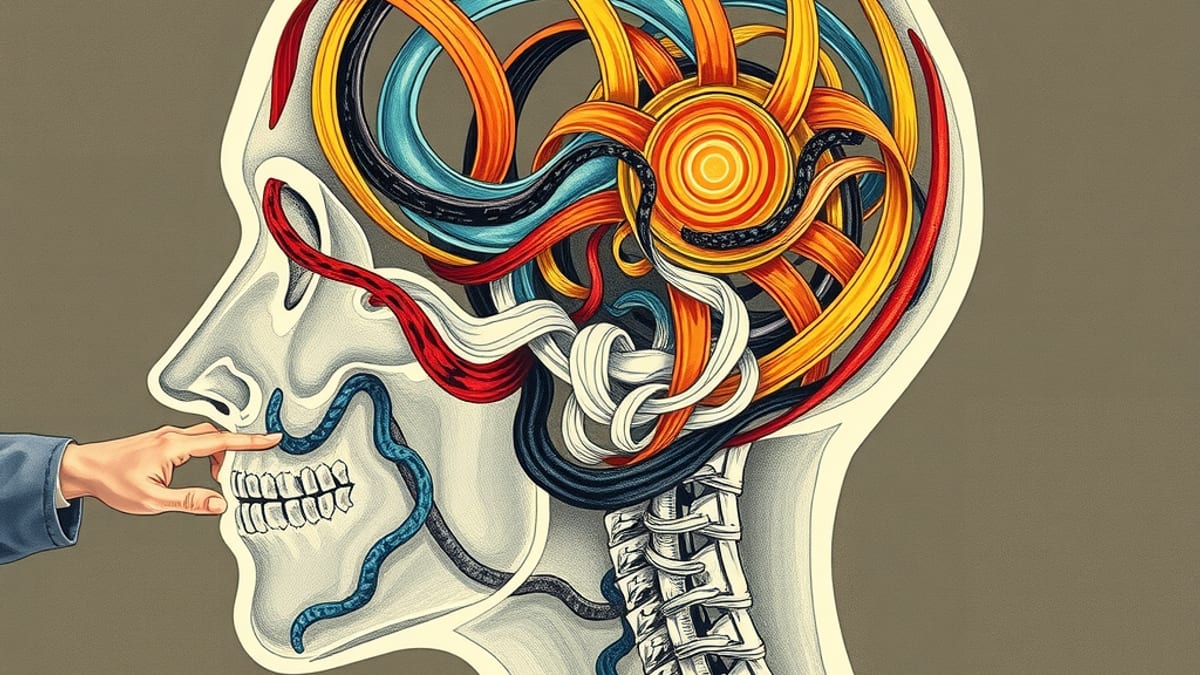
Scientists have identified unexpectedly complex wave patterns traversing the human brain, suggesting that neural activity is not fixed but dynamically reconfigures itself moment by moment. This finding challenges prior views of brainwaves as mere background signals and points to a more active, adaptive processing system. The research, detailed in a study published in Advanced Science, utilized a novel neuroimaging technique called FREQ-NESS (Frequency-resolved Network Estimation via Source Separation) to analyze brain signals.
This new method allows researchers to disentangle overlapping brain networks based on their dominant frequencies. By isolating these frequency-specific networks, scientists can trace their spatial propagation across the brain. Previous understandings often treated brainwaves like distinct radio stations, alpha, beta, gamma, and brain anatomy as separate regions. However, FREQ-NESS reveals a richer picture, showing how frequencies shift and spread, adapting to incoming stimuli and internal states.
During experiments involving rhythmic sounds, researchers observed significant shifts in brainwave activity. For instance, alpha waves, typically associated with resting states, moved from the posterior regions of the brain to areas involved in action planning when participants heard beeps. The frequency of these alpha waves also increased, from approximately 10.9 hertz to 12.1 hertz. This dynamic reallocation of neural resources indicates that the brain actively reorganizes its networks in response to auditory input.
The study, led by Dr. Mattia Rosso and Associate Professor Leonardo Bonetti at Aarhus University's Center for Music in the Brain, in collaboration with the University of Oxford, also noted that faster gamma waves interact with slower low-frequency oscillations in real time. This suggests a greater degree of cooperation between different neural communication speeds than previously assumed. While some neural signals remained stable, such as activity around 23 hertz in sensorimotor regions, others demonstrated clear real-time adaptation.
This work builds upon a growing body of research exploring the brain's rhythmic structure and its role in cognition, perception, and consciousness. The ability to map these dynamic brain networks with high precision using FREQ-NESS could have significant implications for future research. Potential applications include advancing our understanding of music cognition, attention, and even developing new diagnostic tools for mental health conditions. The technique's capacity to reveal how the brain reshapes itself in response to external stimuli offers a powerful new lens through which to study brain function.