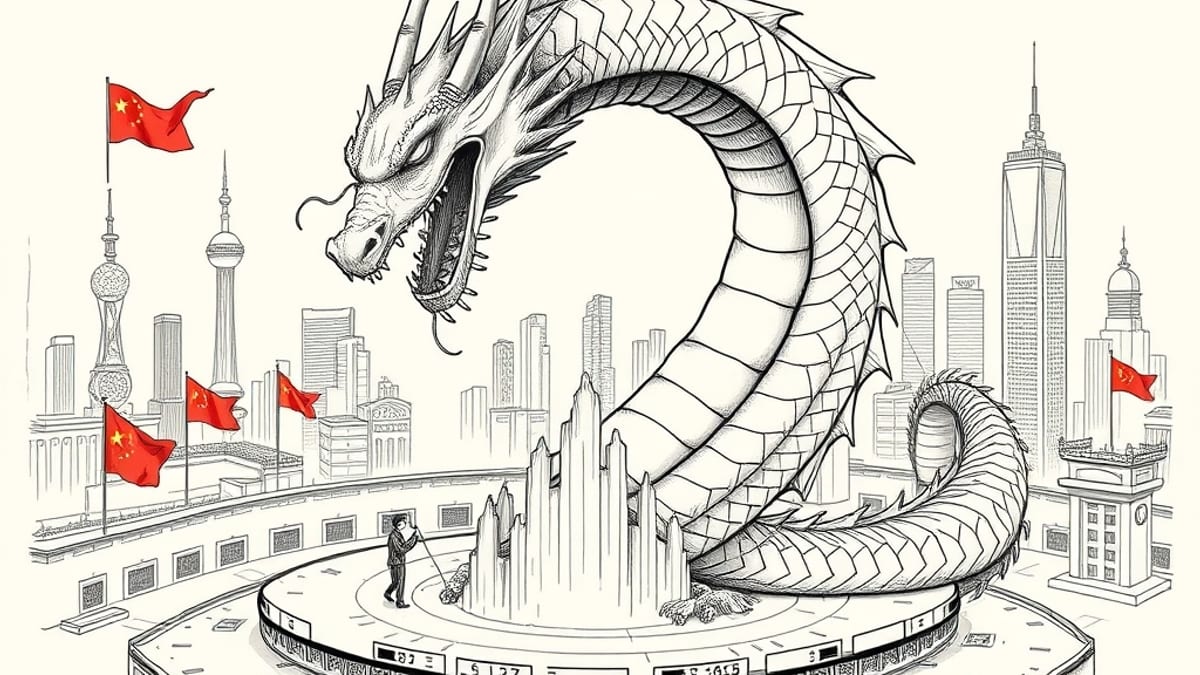
Shares of Chinese memory chipmaker CXMT Corp. soared 466% on their Shanghai trading debut on Monday, July 27, 2026, catapulting the company to the top of China's stock market by valuation. The company's initial public offering, the largest in Asia for the year, raised 57.92 billion yuan ($8.6 billion). The rally lifted CXMT's market capitalization to 3.3 trillion yuan (approximately $487.73 billion), surpassing long-standing market leaders like the Industrial and Commercial Bank of China.
The blockbuster debut underscores a strong investor appetite for domestic semiconductor firms, driven by Beijing's push for self-sufficiency in advanced chipmaking. This initiative is occurring amid intensified U.S. export controls and booming global demand for artificial intelligence infrastructure. CXMT, China's leading producer of DRAM memory chips, has emerged as a key player in this strategic sector. DRAM chips are essential for temporary data storage during processing and are utilized in AI servers, personal computers, smartphones, and automobiles.
CXMT's performance is seen as a direct challenge to the global dominance of established memory chipmakers such as Samsung Electronics, SK Hynix, and Micron Technology. The stock prices of these competitors saw a decline following CXMT's listing. Analysts suggest that Chinese chip companies may follow a pattern seen in other industries, such as steel and automobiles, by undercutting and outcompeting Western firms on price.
Adding to the pressure on Western chipmakers, reports emerged on the same day as CXMT's IPO that China had developed its own deep-ultraviolet (DUV) lithography tools. This technique is critical for computer chip manufacturing, a process where the Dutch company ASML had previously held a monopoly. While industry experts caution that producing these machines is only the initial step, and achieving high-volume, reliable chip production remains a significant challenge, the development signifies China's ongoing efforts to reduce its reliance on foreign technology.
CXMT's rapid ascent highlights China's strategic elevation of semiconductor development. The company's business has thrived as China seeks greater self-sufficiency in advanced technologies while contending with restricted access to certain chipmaking equipment due to U.S.-led restrictions. CXMT's IPO funds are earmarked for expanding production capacity, research and development, and working capital. The company generated 50.8 billion yuan in revenue in the first quarter of 2026, an increase of over 700% year on year, reflecting the growing demand for memory chips amid investments in AI servers.
Despite its impressive debut, analysts point out that CXMT still faces technological barriers to fully compete with global leaders. The primary bottleneck remains China's limited access to the most advanced chipmaking equipment, particularly ASML's extreme ultraviolet (EUV) lithography systems, which are essential for producing the most cutting-edge processors. However, China's immediate objective may be to secure a reliable domestic supply chain to support its AI ambitions, rather than solely matching the performance of the world's most advanced memory chips. The strategic value for China's domestic AI development lies in supply-chain security and scale.
The market's reaction reflects broader concerns about the sustainability of AI spending and the valuations of tech stocks. The intensifying competition from Chinese manufacturers could lead to downward pressure on pricing power, market share, and profit margins for industry leaders globally. Investors are now reassessing company valuations, which have reached historic highs driven by the AI boom.