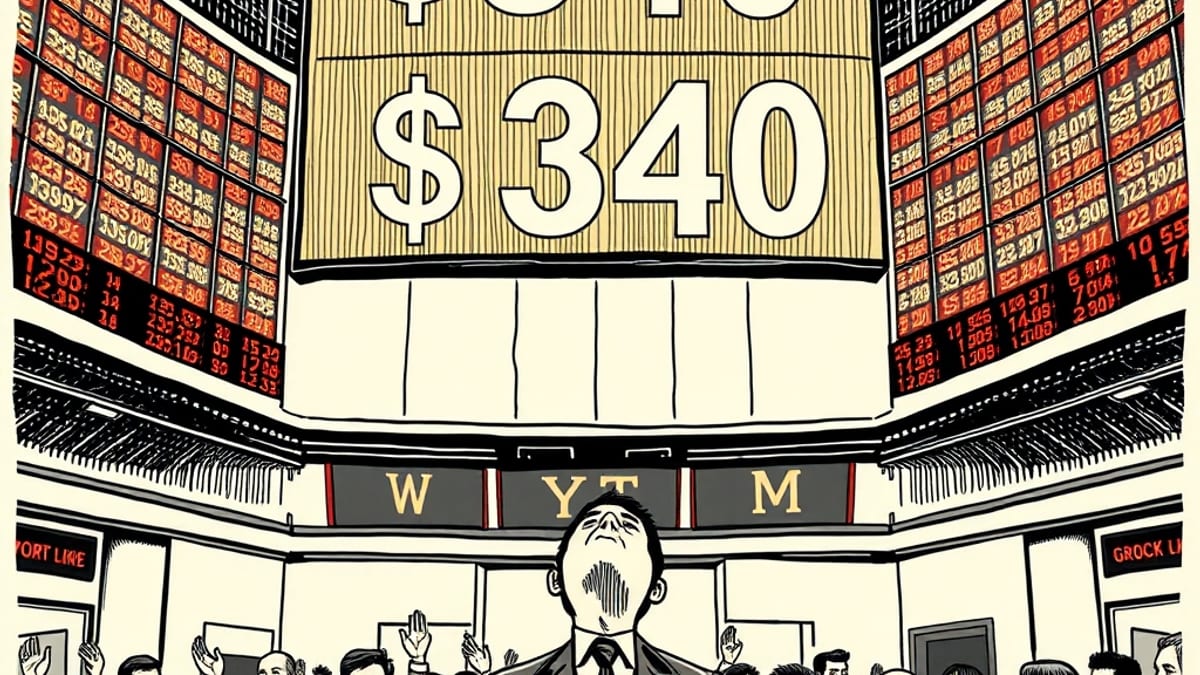
Apple reached a market capitalization of $5 trillion during intraday trading on Tuesday, July 28, 2026, becoming the second company in history to achieve this valuation. The iPhone maker's stock surge was fueled by strong product demand and a strategic avoidance of the costly artificial intelligence infrastructure race, contrasting with the performance of its rivals.
Apple briefly surpassed $5 trillion in market value on Tuesday, July 28, 2026, reaching an intraday high of $342.89 per share. This milestone positions Apple as only the second company, after Nvidia, to ever achieve such a valuation. The company's stock performance has been bolstered by robust demand for its products, particularly the iPhone, and its Services division, which continues to show significant growth. This surge occurred amidst a broader sell-off in technology stocks, particularly those heavily invested in artificial intelligence development.
The iPhone maker's valuation climb is attributed to its consistent product demand and a strategic decision to not engage in the high-capital expenditure race for AI infrastructure that has pressured many of its competitors. While companies like Alphabet and Amazon are projected to spend hundreds of billions on AI-related capital expenditures, Apple's own capital expenditures have remained comparatively small, with its expected fiscal 2026 free cash flow projected to exceed $140 billion. This fiscal prudence has resonated with investors, who appear to favor Apple's model of generating substantial returns with lower investment in AI hardware.
Apple's stock has climbed approximately 24% year to date and about 60% over the past year, a performance that has allowed it to reclaim the title of the world's most valuable public company from Nvidia, which saw its market value slide from its May peak. This shift in market leadership underscores a rotation of investor capital away from the high-priced AI trade towards more established, cash-generative businesses like Apple.
The company's fiscal performance has been strong, with record revenues reported in its fiscal second quarter ending March 28, 2026. iPhone revenue, in particular, saw a significant jump of 23% to $85.3 billion during the fiscal first quarter of 2026. The Services segment also contributed a record $30.9 billion in the March quarter, driven by expanding subscriptions and recurring revenue. This consistent financial strength provides a solid foundation for Apple's valuation.
This valuation milestone occurs as Apple is preparing for a significant leadership transition. Tim Cook is scheduled to step down as CEO on September 1, 2026, handing the reins to John Ternus, the current head of hardware. Cook will move to the role of executive chairman. The company is also set to report its fiscal third-quarter earnings on July 30, 2026, which will be Cook's final earnings call as CEO. Investors will be closely watching to see if Apple can sustain its iPhone demand, demonstrate progress with its revamped Siri, and continue its growth trajectory under new leadership.
Apple's history of reaching valuation milestones has been marked by intraday touches before sustained closing prices. The company first surpassed $1 trillion in August 2018, followed by $2 trillion in August 2020, and $3 trillion in January 2022. It reached $4 trillion in October 2025, with Nvidia and Microsoft achieving similar milestones earlier. Apple's consistent share buyback program has also played a role in its financial performance, reducing the number of outstanding shares and enhancing earnings per share, although it also requires a slightly higher share price to reach future market capitalization targets.