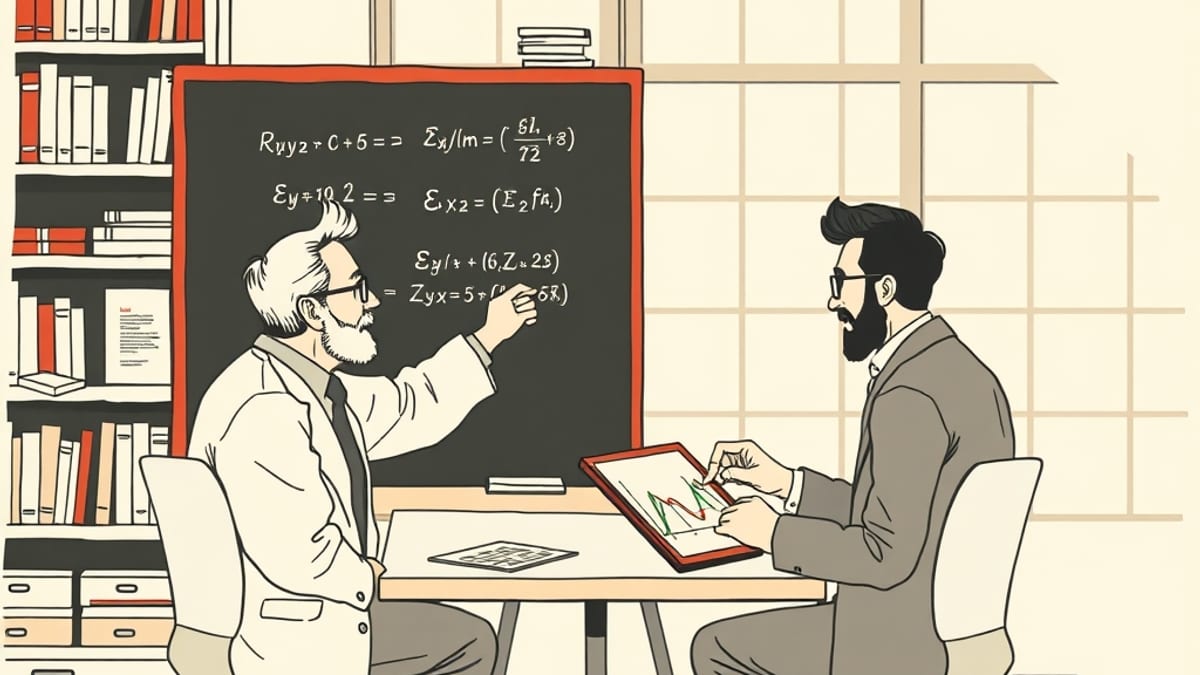
A research paper published on arXiv details how an AI system, developed by a team including academics from the University of Texas, Princeton University, and UCLA, contributed to improving the bounds of the Grothendieck constant ($K_G$). The constant, an open problem in mathematics since 1953, quantifies the relationship between combinatorial problems and their continuous relaxations. The new bounds established are $6\pi/11 \le K_G \le \pi/(2\log(1+\sqrt{2})) - 10^{-4}$. These improvements were achieved through a human-AI collaborative framework, where the AI system generated insights that human domain experts recognized as novel.
The Grothendieck constant plays a role in various fields, including the geometry of Banach spaces, C*-algebras, harmonic analysis, and computer science, particularly in approximation algorithms. Despite its importance, the exact value of $K_G$ has remained elusive. Previous efforts to bound the constant, such as Krivine's work in 1977, provided an upper bound, which was later refined. The current research focused on tightening both the upper and lower bounds.
The AI research system was designed to operate with a degree of autonomy, making decisions on what to pursue next and learning from prior attempts. The system was asynchronously guided by human operators, who provided high-level direction and interpreted the AI's outputs. This structured approach allowed the AI to engage with a complex, ill-defined mathematical problem.
The researchers noted that the AI system exhibited an asymmetry in its capabilities. It demonstrated strength in technical execution, such as developing lemmas and proofs and running computations. However, its performance was less reliable in broader research judgment and maintaining a comprehensive understanding of the overall research state. This suggests that while AI can be a powerful tool for specific mathematical tasks, human oversight remains important for strategic direction and contextual understanding.
One instance highlighted in the paper described how the AI system, after initial failures in an upper-bound search, reframed these failures as evidence for a universal obstruction. This reinterpretation led the system to develop a central proof for the lower bound with minimal further human intervention. This demonstrates the AI's capacity for creative problem-solving within a defined scope, especially when guided by human reframing of challenges.
The project ran from June 16 to July 24, 2026. The methodology involved combining reasoning models, coding agents, and calibrated verification to create a long-horizon AI-assisted mathematics framework. The researchers emphasize that their work provides insights into the strengths and weaknesses of AI as a mathematical collaborator. This case study contributes to the ongoing discussion about how AI can be effectively integrated into advanced mathematical research to accelerate discoveries and address long-standing open problems. The findings suggest a future where human mathematicians can focus on conceptual innovation, using AI to manage and execute complex computational and proof-finding tasks.