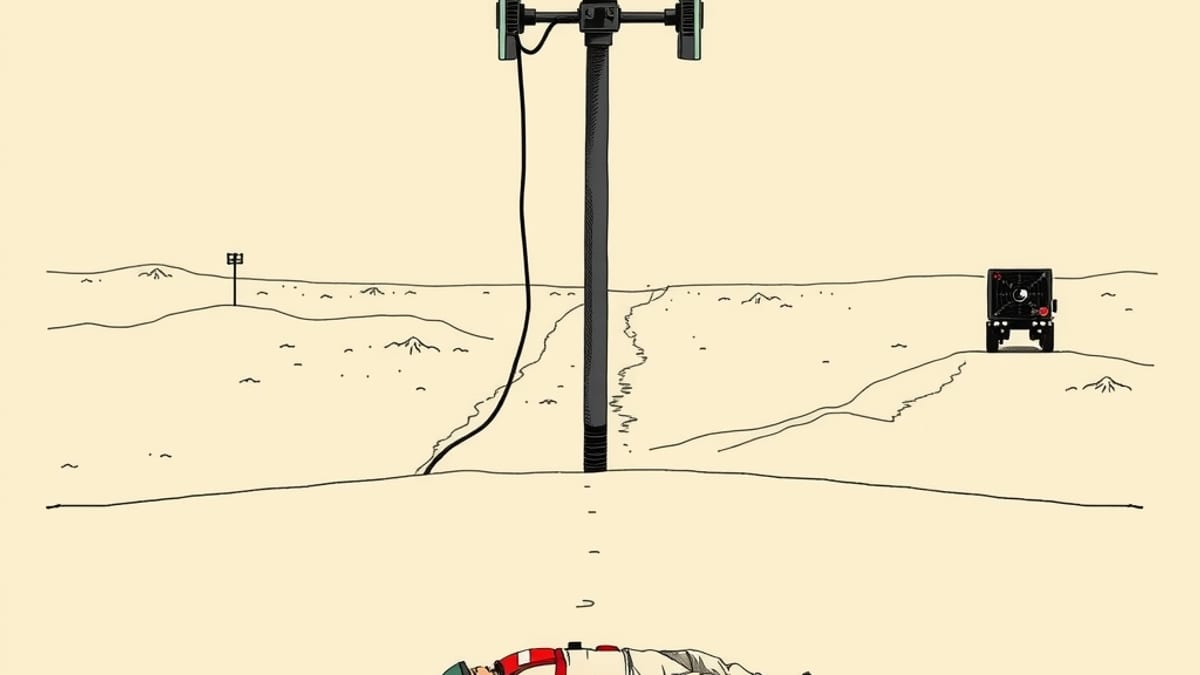
On April 8, 2024, José Morales Bernal, 31, died in the New Mexico desert within sight of three newly installed surveillance towers built by the defense technology company Anduril. These towers, equipped with cameras and artificial intelligence, were designed to automatically detect and track individuals crossing the US-Mexico border and alert agents. Despite this technology, landfill employees, not Border Patrol agents, first spotted Morales that morning. They later found him lying in the sand and called Border Patrol, who arrived 45 minutes after the 4 p.m. call to find him dead from environmental exposure.
Morales's death is not an isolated incident. A collaborative investigation by MIT Technology Review and Times of San Diego found more than 1,050 people died within the advertised range of border surveillance towers between 2015 and early 2026. The investigation further revealed that 110 of these deaths occurred within range of modern autonomous towers from Anduril, which are among the most advanced systems deployed by US Customs and Border Protection (CBP) since 2021. In the same stretch of desert where Morales died, 18 other individuals also perished within range of the three Anduril towers that year. Five of those deaths were visible from the same tower closest to Morales's body.
The US government has invested billions of dollars over 25 years in building a "virtual wall" along the border, which includes various generations of towers, blimps, drones, and seismic sensors. The One Big Beautiful Bill Act (OBBA), signed into law in July 2025, allocated over $6 billion for border surveillance technology, with approximately $1 billion designated for autonomous AI-powered surveillance towers. CBP Commissioner Rodney Scott has stated that this technology maximizes the use of agents and provides "persistent surveillance" and "situational awareness" to detect border crossers and facilitate interception, also crediting it with saving lives.
However, the investigation indicates these systems are failing to achieve their stated objectives of identifying and locating migrants. In some instances, migrants have died after being within the field of view of surveillance cameras. For example, Graciela Gómez Hernández, 30, died in September 2025 in the Otay Mountain Wilderness, just one mile from a General Dynamics tower with long-range cameras. A topographical analysis estimated that over half of the remains tallied in the past four years were found in locations where a camera would have had a clear view.
Civil rights groups and privacy advocates, including the Electronic Frontier Foundation, have questioned the efficacy and accountability of these surveillance towers for years. Dave Maass, director of investigations at the Electronic Frontier Foundation, noted that studies have not consistently demonstrated the effectiveness of surveillance towers for situational awareness or deterring illegal immigration. The Government Accountability Office (GAO) reported in July 2026 that the Department of Homeland Security (DHS) plans to increase the "Integrated Surveillance Towers Program" from 830 to 2,300 towers by 2034. Despite these expansion plans, the core issue of preventing deaths near these surveilled areas remains unresolved.