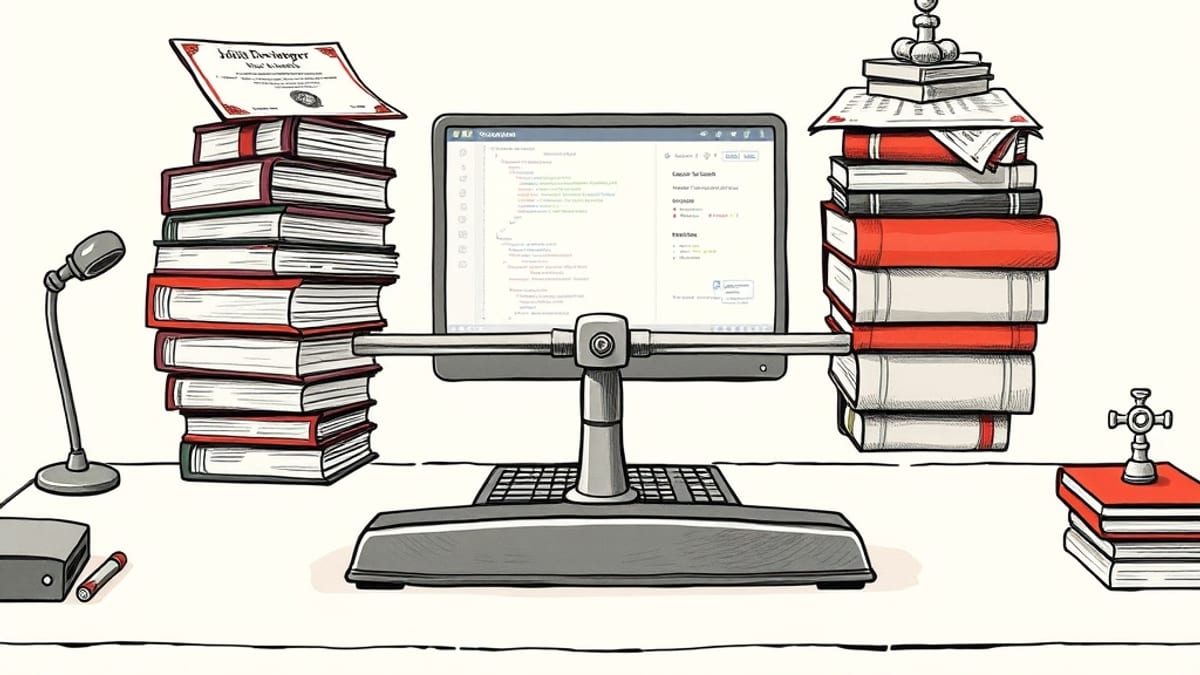
The landscape of software engineering is undergoing a significant transformation as artificial intelligence tools automate tasks previously handled by mid-level professionals. This shift is leading to a contraction of traditional mid-level roles, creating a so-called "barbell economy" where opportunities are increasingly concentrated at the junior and senior ends of the career spectrum. This phenomenon is altering the established career progression for software engineers, moving away from a broad base of junior developers to a solid middle layer, and a small apex of senior architects.
Generative AI coding agents, such as GitHub Copilot and Cursor, are now capable of performing routine coding, bug fixing, and even writing complete functions with increasing autonomy. This automation reduces the need for human intervention in many tasks that formed the core responsibilities of mid-level engineers. Consequently, companies are restructuring their hiring strategies, with a growing emphasis on highly skilled senior engineers who can manage AI systems and design complex architectures, and a potential for more entry-level roles that are "AI-native".
This change disrupts the traditional career pipeline, which often involved junior engineers progressing through mid-level roles to gain experience and technical mastery. Without the opportunity to grapple with routine coding tasks, the next generation of developers may lack the foundational experience needed for advanced roles. Some analyses suggest that junior developer employment may drop as AI automates entry-level tasks, while senior employment remains largely unaffected. However, other perspectives indicate that AI tools can help junior developers overcome initial hurdles more quickly, potentially making them more valuable.
The rise of AI-powered tools is not merely an acceleration of existing trends but a fundamental reshaping of the software development lifecycle. AI is impacting everything from code suggestion and documentation to testing, deployment, and maintenance. Tools like GitHub Copilot provide autocomplete functionalities, while AI-native editors and coding agents assist with multi-file tasks and code refactoring. AI code review tools and debugging agents are also streamlining processes that previously demanded significant human effort.
This evolution is leading to a demand for new skill sets. While routine coding tasks are being automated, there is an increasing need for roles in areas such as AI operations, model safety, prompt engineering, and human-centred design. Engineers who can effectively integrate AI into development workflows and enhance the developer experience are becoming highly sought after. This necessitates a continuous upskilling effort, with Gartner predicting that 80% of engineers will need to upskill by 2027 due to generative AI.
The economic implications of this shift are substantial. The tech industry has seen significant layoffs, with companies citing AI efficiencies as a reason for reducing headcount. This trend is not limited to software engineering, affecting various white-collar professions where AI can automate tasks previously performed by middle-skill workers. The concentration of opportunities at the extremes of the "barbell economy" means that individuals without the specialized skills for senior roles or the adaptability for new AI-focused positions may struggle to find stable employment.
While the automation of tasks might suggest a reduced demand for software engineers overall, many experts believe AI will act as a force multiplier, enabling development work to expand into new domains. The Bureau of Labor Statistics still projects growth in software jobs, but this growth may be accompanied by a significant restructuring of roles and required skills. The key for professionals will be to embrace AI as a tool for enhancement rather than viewing it as a direct replacement.
The long-term impact hinges on how companies choose to deploy AI. If AI is used primarily for cost-cutting and headcount reduction, the middle class of software engineering may continue to shrink. However, if AI is leveraged to expand output and create new opportunities, the industry could see a different trajectory, albeit one that requires continuous adaptation and skill development from its workforce. The challenge for the industry will be to create new pathways for talent development and ensure that the benefits of AI are broadly shared, rather than exacerbating existing economic divides.