Scientists at Aalto University in Finland have developed a superconducting quantum heat engine that operates cyclically, demonstrating the conversion of heat into usable work at temperatures approaching absolute zero. This achievement marks the first instance of a cyclic quantum heat engine built within a superconducting circuit, a platform central to modern quantum computing technologies. The research, led by Academy Professor Mikko Möttönen, appeared in Nature Communications.
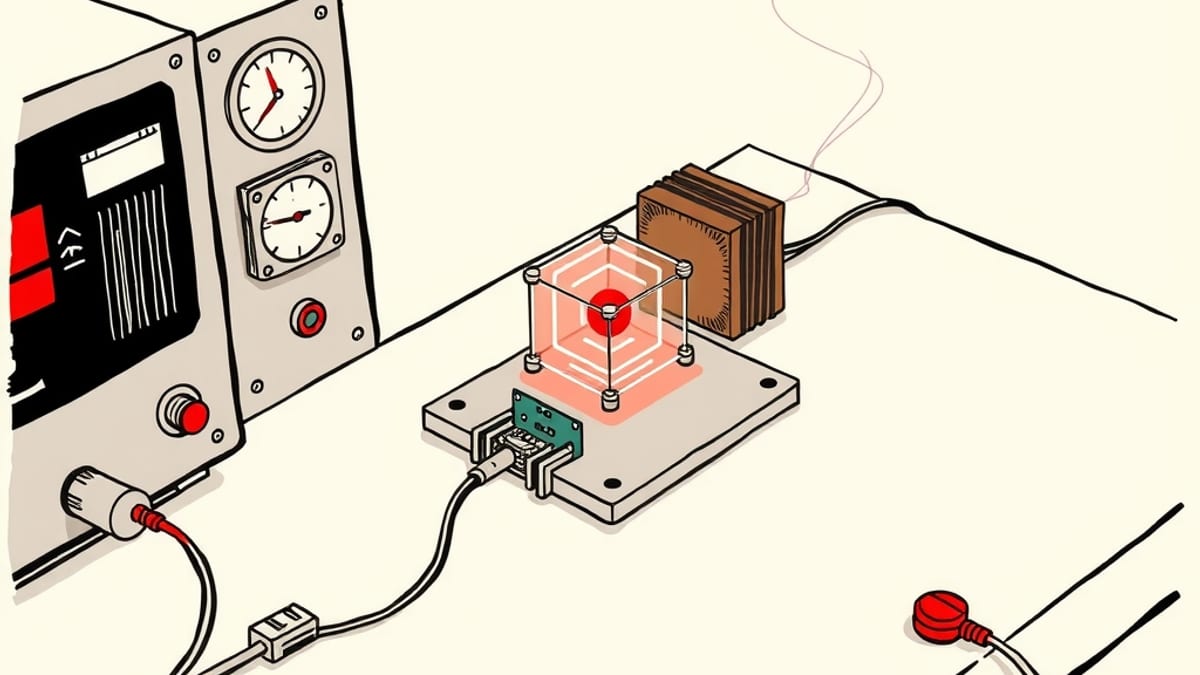
The experimental device, smaller than a grain of sand, incorporates a transmon qubit, a resonator, and a quantum-circuit refrigerator. A transmon qubit serves as the working medium of the engine, analogous to the gas in a conventional piston engine. The researchers manipulated the qubit's energy levels using magnetic-flux pulses and controlled its temperature with the quantum-circuit refrigerator. This refrigerator uniquely functioned as both the hot and cold environment for the engine, a departure from traditional heat engines that require separate thermal reservoirs.
To operate the engine, the team reproduced an Otto cycle, a thermodynamic process common in internal combustion engines. Through carefully timed control pulses, they drove the qubit through the four stages of this cycle: heating, expansion, cooling, and compression. Measurements confirmed that heat flowing through the qubit during the cycle generated positive work. Tuomas Uusnäkki, the study's first author, noted that this is the first experimental demonstration of a cyclic quantum heat engine in superconducting circuits. He added that using a single, controllable quantum refrigerator for both heating and cooling simplifies the engine's design and increases its versatility.
This development holds implications for the advancement of quantum computing. Current superconducting quantum computers require numerous microwave cables to connect room-temperature electronics to the cryogenic processors operating near absolute zero. These cables introduce complexity, cost, and can be sources of unwanted heat and noise, hindering the scalability of quantum systems. The Aalto University team envisions future versions of their quantum heat engine operating autonomously within quantum computers. Such autonomous devices could potentially eliminate many of these microwave cables, simplifying the architecture and reducing noise in large-scale quantum computers.
While the immediate power output and efficiency of the demonstrated engine are low, and the initial cycles do not begin in a steady state, the experiment provides a proof of concept for superconducting heat engines. The researchers suggest that performance could be enhanced through stronger cooling, weaker heating, or by operating the engine over additional cycles. The team is now working towards developing a fully autonomous version of the engine. One potential application for an autonomous engine is assisting with qubit readout directly within the cold circuit, further reducing the reliance on external microwave signals.
Previous demonstrations of quantum heat engines have utilized various quantum systems, including trapped ions, nuclear spins, and cold atoms. However, this is the first time such an engine has been realized using superconducting circuits, which are a leading platform for quantum computing. This research contributes to a deeper understanding of how thermodynamics behaves at the quantum scale, bridging the gap between classical thermodynamic principles and the unique phenomena of quantum mechanics.